English
- English
- Español
- Português
- русский
- Français
- 日本語
- Deutsch
- tiếng Việt
- Italiano
- Nederlands
- ภาษาไทย
- Polski
- 한국어
- Svenska
- magyar
- Malay
- বাংলা ভাষার
- Dansk
- Suomi
- हिन्दी
- Pilipino
- Türkçe
- Gaeilge
- العربية
- Indonesia
- Norsk
- تمل
- český
- ελληνικά
- український
- Javanese
- فارسی
- தமிழ்
- తెలుగు
- नेपाली
- Burmese
- български
- ລາວ
- Latine
- Қазақша
- Euskal
- Azərbaycan
- Slovenský jazyk
- Македонски
- Lietuvos
- Eesti Keel
- Română
- Slovenski
- मराठी
- Srpski језик

How Can Pure Water System Design Address Fluctuating Industrial Water Demand?
Industrial water consumption rarely remains constant throughout a working day. A manufacturing plant may require a high volume of treated water during production shifts, a lower flow during equipment cleaning, and very little water during weekends or scheduled maintenance. If treatment capacity is designed around average consumption alone, the facility may struggle to meet peak demand or operate inefficiently when water requirements fall. A well-planned Pure Water System addresses these changes through appropriate treatment capacity, storage volume, pump control, process configuration and real-time monitoring.
For industrial operators, the objective is not simply to produce more water. It is to deliver the required quantity at the specified quality, pressure and time while keeping energy consumption and operating costs under control. Jianyun Zhishui (Qingdao) Industrial Technology Co., Ltd. develops reverse osmosis water treatment equipment with configurable production capacities and multi-stage filtration. By matching system design to actual consumption patterns, our engineering approach can help facilities manage demand peaks, reduce unnecessary operation and maintain a dependable supply for production.
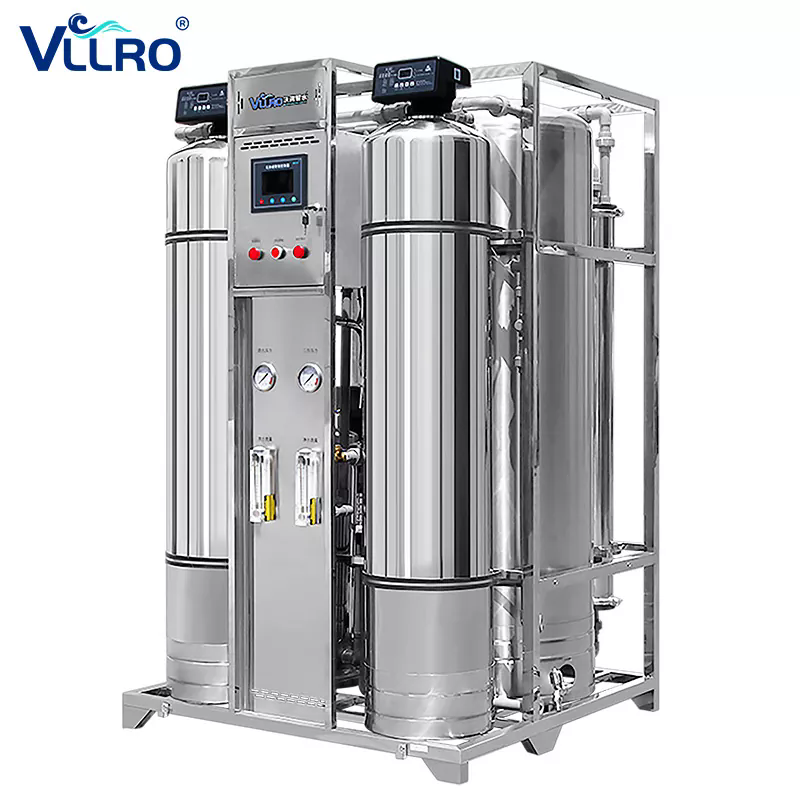
Table of Contents
1. What Makes Industrial Water Demand Difficult to Predict?
2. How Can Treatment Capacity and System Configuration Adapt to Changing Demand?
3. Why Are Storage, Pump Control and Monitoring Essential for Stable Operation?
What Makes Industrial Water Demand Difficult to Predict?
Industrial water demand is influenced by production schedules, equipment operating cycles, cleaning requirements, product specifications and the number of production lines running simultaneously. These factors can change from one hour to another. A food processing facility, for example, may use relatively little treated water during preparation but experience a substantial increase during washing, rinsing and batch production. An electronics manufacturer may have a more continuous baseline requirement, with additional demand during equipment maintenance or process changeovers. The treatment plant must account for both the normal operating load and these temporary increases.
How Do Different Consumption Patterns Affect System Sizing?
The first step in system design is to distinguish average demand from maximum demand. Average demand describes the volume consumed over a selected period, while peak demand represents the highest short-term flow that the facility needs to draw. Designing only around the average can leave the plant short of water during production peaks. Designing entirely around the highest possible demand, however, may result in oversized equipment that operates inefficiently for much of the day.
Our project assessment should therefore examine several operating conditions rather than rely on a single consumption figure:
- Baseline demand: The minimum continuous volume needed to support essential production and utility operations.
- Normal operating demand: The typical hourly requirement during standard production shifts.
- Peak demand: The highest expected flow when several production processes operate at the same time.
- Intermittent demand: Short-duration requirements caused by cleaning, rinsing, tank filling or batch processing.
- Future demand: Additional water requirements associated with planned production expansion or new equipment.
These figures should be collected from flow meters, production records, equipment specifications and discussions with plant operators. Where historical data is available, hourly and daily consumption profiles can reveal patterns that are not obvious from monthly water bills. Where a new facility has no operating history, engineers can estimate demand using the rated consumption of each production line and the expected operating schedule. The estimates should then be checked against the actual process sequence to avoid counting simultaneous water use incorrectly.
Why Can Peak Demand Be Different from Total Daily Consumption?
A facility that uses 30 cubic metres of treated water per day does not necessarily need to produce 30 cubic metres in one continuous operating period. If most of that water is consumed during a few production hours, the required instantaneous supply rate may be considerably higher than the daily average suggests. Conversely, a facility with steady consumption throughout the day may operate effectively with a smaller production rate and a limited storage buffer.
This distinction is important because treatment equipment has a defined production rate under specified feed-water and operating conditions. Reverse osmosis output can be influenced by feed-water temperature, pressure, salinity, membrane condition and recovery settings. A nominal production figure should therefore not be treated as an unconditional guarantee of output under every site condition. Our design calculations should use the expected operating envelope and include an appropriate allowance for variations in raw-water quality and equipment availability.
Which Site Conditions Should Be Considered Before Selecting Equipment?
Demand is only one part of the design calculation. Raw-water conditions and the required treated-water quality also affect the practical capacity of a treatment plant. Groundwater, municipal supply and surface water can have different levels of dissolved solids, hardness, suspended matter, iron and organic contamination. These differences influence pretreatment requirements, membrane loading, cleaning frequency and the operating pressure needed to achieve the target output.
Before finalising a design, the project team should review:
- Raw-water source and seasonal changes in feed-water quality.
- Raw-water TDS, turbidity, hardness and iron concentration.
- Required product-water quality for each production process.
- Hourly consumption data and the duration of demand peaks.
- Available space for treatment equipment and storage tanks.
- Power supply, drainage, pipework and installation conditions.
- Planned production increases and maintenance arrangements.
For example, a plant with a stable municipal water supply may need a different pretreatment arrangement from a facility using groundwater with variable hardness and iron content. A change in feed-water quality can reduce effective membrane output or increase the frequency of maintenance. The design should therefore consider the quality of incoming water alongside the required production rate. This avoids selecting equipment based solely on a headline capacity figure that may not reflect actual site performance.
Jianyun Zhishui (Qingdao) Industrial Technology Co., Ltd. provides industrial RO equipment with configurable capacities for different water treatment requirements. For project planning, our technical review should connect the plant's consumption profile with the feed-water analysis, target water quality and operating schedule. This creates a more realistic basis for equipment selection than simply choosing the largest available model.
How Can Treatment Capacity and System Configuration Adapt to Changing Demand?
A treatment plant should be designed around the relationship between production rate and consumption rate. When production exceeds consumption, treated water can be directed into a storage tank. When consumption temporarily exceeds the output of the treatment equipment, the tank can provide the additional volume. This arrangement separates the instantaneous demand of the production process from the continuous or scheduled operation of the purification equipment. It is one of the most practical ways to manage short-term fluctuations without automatically sizing the entire treatment train for the highest momentary flow.
How Should Engineers Match RO Capacity to Actual Consumption?
Reverse osmosis capacity is normally expressed as a volume produced per hour or per day under defined operating conditions. Engineers should compare this rated output with the expected average consumption, the operating hours available and the volume that can be stored between production periods. A system operating for 20 hours per day may meet the same daily requirement as a larger unit operating for 10 hours, provided the storage arrangement and production schedule are suitable.
For example, a facility requiring 24 cubic metres of treated water per day could theoretically meet its daily requirement with an average production rate of 1.2 cubic metres per hour over 20 operating hours. However, this calculation does not by itself establish the final equipment size. The engineer must also consider recovery rate, downtime, membrane performance, pretreatment capacity, peak consumption and the time available to replenish the storage tank.
Where demand varies substantially, a single large treatment train may not always be the most practical solution. Depending on the project, engineers can consider:
- Parallel treatment trains: Two or more units can be arranged to provide additional production capacity when demand increases.
- Modular capacity expansion: Additional treatment modules can be included in the initial layout or added when production requirements grow.
- Storage-supported operation: Treatment equipment can operate at a planned rate while a tank absorbs short-term differences between production and consumption.
- Duty and standby equipment: A standby pump or treatment unit can provide operational resilience when a main component requires maintenance, subject to the selected configuration.
- Staged operation: Individual treatment trains can be started or stopped according to demand, reducing the need to operate all installed capacity continuously.
What Treatment Configuration Supports Different Water Quality Requirements?
A typical industrial RO process uses several pretreatment stages to protect the membranes and stabilise operation. A common arrangement includes sand filtration, activated carbon filtration, water softening or scale control where required, precision cartridge filtration and the RO membrane stage. Each component has a different function. Sand filtration reduces suspended solids, activated carbon helps remove chlorine and certain organic compounds, softening reduces hardness-related scaling risk, and precision filtration captures finer particles before water reaches the membranes.
The exact process sequence should be selected according to raw-water analysis. Not every facility requires the same treatment train. For example, a softener may be necessary where hardness is a significant scaling concern, while a scale inhibitor may be selected as part of a different pretreatment strategy. If feed-water TDS is high or the required product-water quality is particularly demanding, a two-stage RO arrangement or additional polishing process may be considered. The correct solution depends on the application and the relevant water-quality targets.
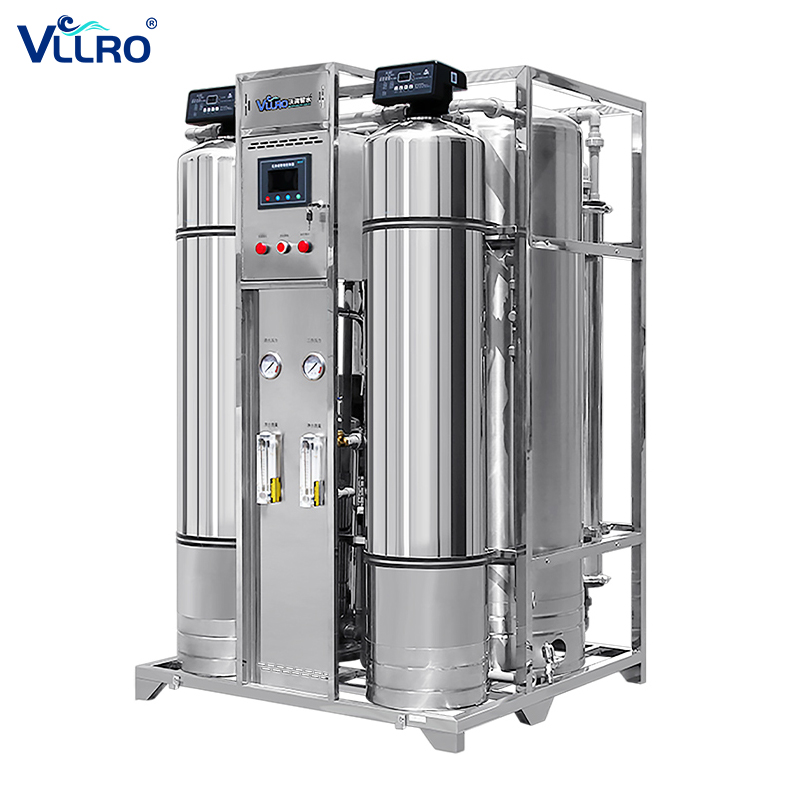
Published VLLRO equipment information provides examples of standard industrial RO configurations. One listed 3.0 T/H model uses a sand, carbon, optional scale-control and precision-filtration sequence before the RO membrane stage. Its published desalination rate is 99.40%, with a selectable electrical supply and a stated raw-water TDS limit below 1500 ppm. These values describe the published model configuration, not a universal performance guarantee for every feed-water condition or customised project.
What Published Equipment Parameters Can Help With Initial Planning?
The following table summarises representative parameters published for the VLLRO-RO-3.0 configuration. Actual project specifications should be confirmed against the final technical proposal, particularly where feed-water quality, operating hours or peak demand differ from the standard design conditions.
| Parameter | Published specification | Design relevance |
| Model | VLLRO-RO-3.0 | Reference configuration for a 3.0 T/H treatment capacity |
| Water production | 3.0 tons per hour | Provides a starting point for matching production with hourly consumption |
| Desalination rate | 99.40% | Indicates the published salt-removal performance under specified operating conditions |
| Process flow | Sand, carbon, optional scale inhibitor, precision filter, RO membrane | Provides staged pretreatment and membrane protection |
| Voltage | 110V, 220V or 380V selectable | Must be matched to the electrical supply available at the installation site |
| Inlet pressure | 0.2 to 0.4 MPa | Reference feed-water pressure range for the listed configuration |
| RO operating pressure | 0.8 to 1.2 MPa | Operating range stated for the RO stage |
| RO membrane | HuiTong 8040 membranes, three units | Membrane arrangement for the published model |
| High-pressure pump | SHIMGE or equivalent | Provides the pressure required for the RO process |
| Filter tank | 600 x 1900 mm | Reference dimension for the listed filtration configuration |
| Precision filter | Five PP cotton filter elements | Provides fine particulate filtration before the RO stage |
| Raw-water TDS | Below 1500 ppm | Published feed-water limit; site analysis is still required |
| Raw-water turbidity | Below 5 FTU | Indicates the stated feed-water turbidity condition |
| Raw-water iron | Below 0.3 mg/L | Important for assessing pretreatment and membrane fouling risk |
| Inlet and waste outlet | DN40 | Reference connection size for the listed model |
| Pure-water outlet | DN25 | Reference product-water connection size |
How Can a Modular Layout Support Future Production Growth?
Production facilities often expand in stages. A plant may initially operate one production line and later add another line, a larger cleaning system or a new processing area. If the water treatment plant has no allowance for expansion, increasing capacity can require substantial changes to the equipment layout, pipework and electrical infrastructure. A modular design can reduce this disruption by reserving space and connection points for future treatment trains or additional storage.
Modularity should not be interpreted as simply installing extra equipment. Each additional unit must be compatible with the feed-water supply, pretreatment process, product-water header, drainage arrangement and control logic. Engineers should also check whether the existing storage tank, distribution pumps and downstream pipework can handle the increased flow. Otherwise, additional treatment capacity may not translate into a higher usable supply at the point of consumption.
Our equipment selection process should therefore consider both current demand and a realistic expansion scenario. The aim is to avoid unnecessary initial investment while preventing the plant from becoming a bottleneck when production increases. Jianyun Zhishui (Qingdao) Industrial Technology Co., Ltd. lists industrial RO configurations with different output capacities, allowing project requirements to be reviewed against available equipment options. A final configuration should be based on a site-specific calculation rather than a catalogue rating alone.
Why Are Storage, Pump Control and Monitoring Essential for Stable Operation?
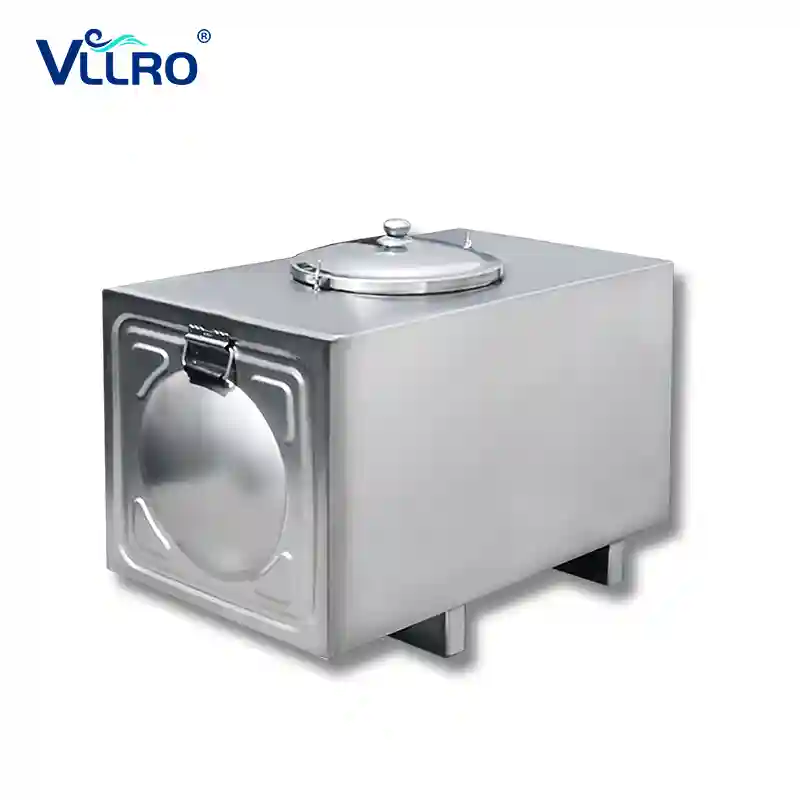
Even when treatment capacity is correctly selected, a plant can experience supply problems if storage and distribution are poorly designed. Treatment equipment produces water at a rate determined by its process conditions, while production equipment may draw water in short and irregular bursts. A storage tank acts as a buffer between these two operating patterns. It allows the treatment plant to replenish water over time and gives the distribution network a reserve that can respond to sudden increases in consumption.
How Should Storage Volume Be Calculated?
Storage capacity should be determined from the difference between treated-water production and actual consumption over the relevant operating period. A tank that is too small may empty during a production peak, while an excessively large tank can increase capital cost and create water-age or hygiene-management concerns. The appropriate volume depends on the duration and magnitude of demand peaks, the treatment plant's replenishment rate, the reliability requirement and the available space.
A practical preliminary calculation can use the following relationship:
Required buffer volume = cumulative water demand during the selected period minus cumulative treatment production during the same period.
The calculation should be performed using time-based data rather than daily averages alone. If a plant consumes 5 cubic metres during a one-hour peak while its treatment unit produces 3 cubic metres in that hour, the storage system must supply the 2 cubic metre difference, before adding any engineering allowance for operating uncertainty or reserve requirements. If the treatment unit produces more than the facility consumes during the following hours, the tank can be replenished.
Storage design also needs to account for usable tank volume rather than simply the nominal tank size. Minimum operating level, high-level cut-off, freeboard and any reserved emergency volume can reduce the amount of water available for normal production. The tank should be sized with the distribution pump arrangement and the treatment plant's control sequence in mind. Our design review should also consider tank material, cleaning access, level instrumentation, overflow protection and the quality requirements of the stored water.
Which Pump and Control Strategies Help Manage Variable Flow?
Pumps should be selected for the actual flow and pressure requirements of the treatment and distribution systems. A pump that is oversized for normal operating conditions may waste energy or cause unstable pressure control. A pump that is undersized may fail to deliver sufficient flow during peak consumption. Variable-frequency drives can be considered for suitable pump applications because they allow motor speed to respond to changing flow or pressure demand. Their suitability depends on pump characteristics, control requirements and the electrical design.
Common control strategies include:
- Tank-level control: Starts or stops the treatment plant according to defined storage tank level limits.
- Pressure control: Adjusts distribution pump operation to maintain the required pressure in the supply header.
- Flow-based control: Uses flow measurement to identify changing consumption and coordinate equipment operation.
- Staged pump operation: Starts additional pumps when demand exceeds the capacity of the lead pump.
- Low-level protection: Prevents distribution pumps from operating when the tank level is insufficient.
- High-level protection: Stops or reduces production when the storage tank reaches its upper operating limit.
Control logic should be designed to prevent rapid cycling. If a pump starts and stops too frequently in response to small changes in demand, it may experience unnecessary mechanical and electrical stress. Appropriate level differentials, minimum run times, pressure bands and interlocks can help reduce this behaviour. The control panel should also provide clear alarm indications for low feed-water pressure, high RO pressure, abnormal conductivity, pump faults and other conditions relevant to the selected equipment.
How Does Monitoring Help Maintain Product-Water Quality?
Flow and pressure measurements show whether the plant is producing and distributing water as expected. Conductivity or TDS monitoring provides an indication of dissolved ionic content in the treated water. When these measurements are recorded over time, operators can identify gradual changes that may indicate membrane fouling, scaling, damaged seals, sensor drift or changes in feed-water quality. Monitoring is particularly useful when demand fluctuates because a sudden change in flow can otherwise be mistaken for a treatment-performance problem.
For effective operation, the plant team should establish normal operating ranges for the key measurements and define what action is required when a value moves outside its expected range. These actions may include checking pretreatment pressure drop, inspecting cartridge filters, reviewing pump operation, testing feed-water quality or arranging membrane cleaning according to the manufacturer's procedure. Online measurements should be supported by scheduled verification using appropriate test methods so that operators do not rely entirely on one sensor.
What Maintenance Practices Protect Capacity During Demand Peaks?
A treatment plant that performs well during commissioning may lose effective output if maintenance is delayed. Cartridge filters can become blocked, membranes can foul or scale, pumps can wear and instruments can drift. These issues may reduce flow or increase energy consumption. When the plant is already operating close to its required capacity, even a moderate reduction in performance can become noticeable during a production peak.
Our maintenance plan should include a documented schedule for the following activities:
- Record feed-water pressure, RO pressure, permeate flow and concentrate flow.
- Track conductivity or TDS trends and investigate unexpected changes.
- Inspect pretreatment filters and replace cartridges according to pressure drop and operating conditions.
- Check pump noise, vibration, leakage and operating current.
- Review membrane performance and clean membranes when operating data indicates the need.
- Verify tank-level sensors, flow meters, pressure gauges and conductivity instruments.
- Keep records of maintenance, component replacement, alarms and water-quality results.
VLLRO offers RO equipment configurations that can be assessed alongside the storage, distribution and control requirements of an industrial site. The treatment skid alone does not determine the reliability of the complete water supply. Our project specification should also define the buffer tank, pumps, pipework, monitoring points, control sequence and maintenance access needed for the facility's actual operating pattern.
Conclusion
Fluctuating industrial water demand is best addressed through a coordinated design that balances treatment capacity, storage volume, pretreatment, pump selection and control logic. Instead of sizing equipment only around average consumption or the highest theoretical peak, engineers should study hourly demand profiles, raw-water quality, production schedules and future expansion plans. A properly configured Pure Water System can then provide a more stable supply while helping avoid unnecessary equipment oversizing and inefficient operation.
Jianyun Zhishui (Qingdao) Industrial Technology Co., Ltd. provides configurable industrial RO water treatment equipment for different capacity and feed-water requirements. Contact our engineering team with your raw-water analysis, required hourly output, daily consumption and peak-demand pattern. We can review the application and recommend a suitable treatment configuration, with the relevant technical parameters and project requirements clarified before quotation.
Frequently Asked Questions
How do I calculate the required capacity of an industrial pure water treatment plant?
Start by collecting hourly consumption data for each production process, then identify average demand, maximum simultaneous demand and the number of operating hours available for water production. Compare the required daily volume with the treatment plant's expected output under actual feed-water conditions. Include storage replenishment time, maintenance downtime, membrane performance variation and any planned production expansion. The final capacity should be checked against both the hourly peak and the total daily requirement.
Can a reverse osmosis plant operate efficiently when industrial water consumption changes throughout the day?
Yes, provided the system is designed with suitable capacity management and control. Storage tanks can absorb short-term differences between production and consumption, while staged treatment trains or appropriately configured pumps can respond to changes in demand. The control sequence should avoid excessive start-stop cycling and maintain the operating limits specified for the RO membranes and pumps. The best arrangement depends on the demand profile, water quality and required supply pressure.
What is the purpose of a buffer tank in an industrial water treatment system?
A buffer tank stores treated water so that the distribution network can meet short-term demand peaks even when the treatment equipment produces water at a lower, steadier rate. It also provides time for the treatment plant to replenish the supply between peaks. Tank volume should be calculated from the difference between production and consumption over the relevant period, while allowing for minimum operating level, reserve volume, hygiene requirements and the available installation space.
Which raw-water parameters affect the actual output of an industrial RO system?
Important parameters include total dissolved solids, water temperature, turbidity, hardness, iron concentration and the presence of substances that can cause scaling or membrane fouling. Feed-water pressure and pretreatment performance also affect RO operation. Higher salinity or lower water temperature can influence permeate production, while suspended solids, hardness and iron may increase fouling or scaling risks. A feed-water analysis is therefore necessary before confirming rated capacity and selecting the pretreatment process.
How can a factory prepare its water treatment system for future production expansion?
Review the expected increase in hourly and daily water demand before finalising the initial plant layout. Consider reserving space for additional treatment trains, providing suitable connections to the feed-water and product-water headers, and checking whether storage tanks, pumps, electrical supply and drainage can support a future increase in capacity. Expansion provisions should be included in the engineering design so that additional equipment can be integrated without major changes to the existing installation.
Related News
- Why Should Raw Water Analysis Come Before Pure Water System Equipment Selection?
- What Are the Main Stages of an Industrial Water Purification Process?
- How to Reduce Wastewater in Commercial RO Systems Without Sacrificing Membrane Life
- How to Calculate ROI for a Commercial Water Refilling Station
- How to Design a Borehole Water Pretreatment System for Remote Commercial RO Stations
- The "Brain" Behind the System: How VLLRO's Intelligent IoT Control Platform Revolutionizes Water Management
Leave me a message
New Products


News Recommendations