English
- English
- Español
- Português
- русский
- Français
- 日本語
- Deutsch
- tiếng Việt
- Italiano
- Nederlands
- ภาษาไทย
- Polski
- 한국어
- Svenska
- magyar
- Malay
- বাংলা ভাষার
- Dansk
- Suomi
- हिन्दी
- Pilipino
- Türkçe
- Gaeilge
- العربية
- Indonesia
- Norsk
- تمل
- český
- ελληνικά
- український
- Javanese
- فارسی
- தமிழ்
- తెలుగు
- नेपाली
- Burmese
- български
- ລາວ
- Latine
- Қазақша
- Euskal
- Azərbaycan
- Slovenský jazyk
- Македонски
- Lietuvos
- Eesti Keel
- Română
- Slovenski
- मराठी
- Srpski језик

How to Select the Right RO Membrane Model?
How to Select the Right RO Membrane Model? Remember these guide
Choosing the correct RO membrane model can feel overwhelming. There are dozens of sizes, types, pressure ratings, and brands. Over the years, I’ve helped hundreds of clients match the right membrane to their specific needs.
In this guide, I‘ll walk you through each step. By the end, you’ll know exactly how to select the best RO membrane selection for your system – whether it‘s a small home unit or a large industrial plant.
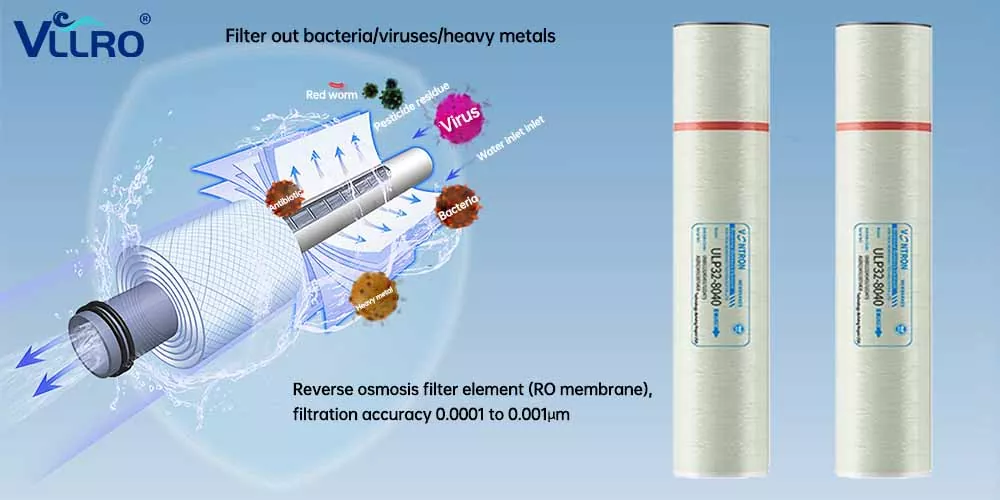
Step 1 – Size by Permeate Flow Rate (Dimension)
The first question I ask every client: How much purified water do you need per hour? This determines the physical size of your membrane element.
Here’s my sizing cheat sheet:
|
Total System Flow |
Recommended Membrane Size |
Typical Application |
|
< 0.2 m³/h |
2.5 inch (2540/2521) or household membrane |
Under sink, small home RO |
|
< 3 m³/h |
4 inch (4040) |
Small industrial / commercial (restaurants, offices, small factories) |
|
> 3 m³/h |
8 inch (8040) |
Large industrial / high capacity (food & beverage, power plants, municipal) |
> Sophia‘s tip: Never oversize or undersize. An oversized membrane wastes money on idle capacity. An undersized membrane runs at max pressure, wears out faster, and can‘t meet peak demand. Always add a 20% buffer to your peak flow when sizing your RO membrane selection .
Step 2 – Select Membrane Type by Feed TDS (Pressure Class)
TDS (Total Dissolved Solids, measured in ppm or mg/L) tells you how much salt and minerals are in your water. Higher TDS requires higher operating pressure to push water through the membrane.
Here‘s my pressure‑based selection guide:
|
Feed TDS Range |
Recommended Membrane Type |
|
500 – 2,000 ppm |
ULP (Ultra Low Pressure) |
|
2,000 – 3,500 ppm |
LP (Low Pressure) – brackish water |
|
3,500 – 5,000 ppm |
FR (Fouling Resistant) or HP (High Pressure) |
|
> 5,000 ppm |
SW (Seawater membrane) |
> If you use a low‑pressure membrane on high‑TDS feed water, you won’t get enough permeate flow. If you use a seawater membrane on low‑TDS tap water, you‘ll waste energy. Match the pressure class carefully.
Step 3 – Verify Operating Conditions (Temperature / pH / Pressure)
Every RO membrane selection must account for your actual operating environment. Here are the limits:
- Temperature – Standard membranes work between 5–45°C. Cold water reduces permeate flow (by about 3% per °C below 25°C). High‑temperature membranes (up to 80°C) are available for food/pharma thermal disinfection.
- pH – Conventional membranes tolerate pH 2–11. Acid/alkali resistant membranes (pH 1–13) are used for special wastewater.
- Pressure – Never exceed the membrane‘s maximum pressure rating. Over‑pressure can collapse or delaminate the membrane.
Real example: A Europe factory in a cold climate tried to run a standard membrane with 8°C feed water. Their output was 40% below design. We added a feed heater – problem solved. Always adjust for temperature.
Step 4– Compare Brand, Lifespan & Total Cost
Finally, choose a brand that fits your budget and reliability needs.
|
Brand Category |
Examples |
Lifespan |
Best For |
|
Tier 1 (global leaders) |
DuPont (FilmTec), Hydranautics, Vontron |
3 – 5 years |
Critical processes, long life, warranty support |
|
Domestic / local brands |
Various (China, India, etc.) |
2 – 3 years |
Non critical applications, tight budgets |
Total cost of ownership (TCO) includes:
- Purchase price
- Energy consumption (higher pressure = higher electricity bills)
- Cleaning chemicals and frequency
- Replacement membrane cost (over 5 years)
Sophia’s experience: A slightly more expensive FR membrane that lasts an extra year and needs half the cleanings is almost always cheaper in the long run than a “bargain” membrane.
Need a quick recommendation? Send me your water test report and required flow. I‘ll propose the exact RO membrane model for your system – free of charge.
Ready to Select Your RO Membrane?
Now that you understand the rule ,you‘re ready to choose with confidence.
Browse our [Replacement RO Membranes]– all sizes and types in stock.
Explore [Complete Commercial RO Systems]– pre‑configured with optimally matched membranes.
Have a specific project? Contact our team with your flow, TDS, and water source. We‘ll deliver a membrane selection within 24 hours.
Related News
- How to Reduce Wastewater in Commercial RO Systems Without Sacrificing Membrane Life
- How to Calculate ROI for a Commercial Water Refilling Station
- How to Design a Borehole Water Pretreatment System for Remote Commercial RO Stations
- The "Brain" Behind the System: How VLLRO's Intelligent IoT Control Platform Revolutionizes Water Management
- The Invisible Shield: Why UV Sterilization is Non-Negotiable for Safe Drinking Water
- Maximizing RO Longevity: The Complete Guide to Water Filtration Consumables and Replacement Cycles
Leave me a message