English
- English
- Español
- Português
- русский
- Français
- 日本語
- Deutsch
- tiếng Việt
- Italiano
- Nederlands
- ภาษาไทย
- Polski
- 한국어
- Svenska
- magyar
- Malay
- বাংলা ভাষার
- Dansk
- Suomi
- हिन्दी
- Pilipino
- Türkçe
- Gaeilge
- العربية
- Indonesia
- Norsk
- تمل
- český
- ελληνικά
- український
- Javanese
- فارسی
- தமிழ்
- తెలుగు
- नेपाली
- Burmese
- български
- ລາວ
- Latine
- Қазақша
- Euskal
- Azərbaycan
- Slovenský jazyk
- Македонски
- Lietuvos
- Eesti Keel
- Română
- Slovenski
- मराठी
- Srpski језик

Why UF + UV Beats RO for Africa Groundwater? 5 Reasons
Ultrafiltration + UV for Africa Groundwater: 5 Reasons to Skip Reverse Osmosis (RO)
Author: Sophia
Water Treatment Engineer, VLLRO | 20 years in rural water solutions for Africa & developing regions
When I first started working on rural water projects in Africa, almost every local partner asked me the same question: “Should we install reverse osmosis (RO) systems?” My answer often surprised them: No – for most African villages, ultrafiltration (UF) + UV is the better choice.
After two decades designing water systems for off‑grid communities across Nigeria, Kenya, Tanzania, Ghana, and Zambia, I have seen too many RO systems abandoned within a year – dead membranes, burnt pumps, empty chemical drums. Meanwhile, simple UF + UV systems keep running for years with minimal maintenance.
In this guide, I will give you five evidence‑based reasons why ultrafiltration + UV beats RO for treating African groundwater – and why RO is often overkill, expensive, and unsustainable for rural communities.
Reason 1 – Water Quality Match: UF Handles Africa‘s Groundwater Better Than RO
African village groundwater and borehole water have a very specific contamination profile:
- High turbidity – sand, silt, colloids (especially after rains)
- Bacteria & microorganisms – E. coli, coliform, parasites
- Low to moderate hardness
- Very rarely high salinity or heavy metals
Here is the key: RO is designed for high TDS (salt) and heavy metals – conditions that are uncommon in most African groundwater. It is like using a fire truck to water your garden. Overkill.
How UF + UV matches the actual problem:
|
Contaminant |
UF (0.1 micron) |
UV |
RO |
Actual Need in Africa |
|
Sand, silt, rust |
✅ Removes |
❌ No |
✅ Removes |
High need |
|
Bacteria, E. coli |
✅ Removes (most) |
✅ Kills 99.9% |
✅ Removes |
High need |
|
Viruses |
! Partial |
✅ Kills |
✅ Removes |
Moderate |
|
Salts (TDS) |
❌ Not removed |
❌ No |
✅ Removes |
Low need |
|
Heavy metals |
❌ Not removed |
❌ No |
✅ Removes |
Very low need |
> UF removes particles down to 0.1 microns – that covers sediment, protozoa, and most bacteria. UV then kills any remaining viruses. The result: safe drinking water that meets WHO guidelines for most rural settings.
Reason 2 – Ultra‑Low Operating Cost (Critical for Africa‘s Supply Chain)
RO systems require:
- High‑pressure pumps (1‑3 kW) – electricity hungry
- Membrane replacement every 1‑2 years – expensive and hard to source
- Pre‑filters (sediment + carbon) – changed every 3‑6 months
- Chemicals (anti‑scalants, cleaning agents) – ongoing cost
- Wastewater disposal – 3‑4 gallons wasted per gallon produced
UF + UV cost comparison:
|
Cost Item |
UF + UV |
RO System |
|
Electricity |
Only UV lamp (20 40W) |
High pressure pump (1 3 kW) |
|
Membrane life |
1 3 years (washable) |
1 2 years (replace) |
|
Replacement cost |
Low (UF membrane ~$50 100) |
High (RO membrane ~$200 500) |
|
Chemicals |
None |
Anti scalants, cleaners required |
|
Wastewater |
Zero (only flush water) |
High (1:3 1:5 waste ratio) |
|
Annual operating cost |
~$50 100 |
~$300 800+ |
In water‑scarce regions, wasting 3‑4 liters for every liter of clean water is simply unacceptable. With UF + UV, every drop is used – critical for communities where water is carried by hand from distant boreholes.
> A village in Tanzania was given an RO system by a charity. Within 18 months, the membranes were scaled, the pump burned out, and no one could afford replacement parts. The system sat unused for years. A nearby village with a UF + UV system is still running strong after 5 years – with just a UV lamp replacement and occasional membrane flushing.
Reason 3 – Low Power Requirement: Works Without Stable Electricity
RO systems need stable, continuous power – a luxury in many African villages. Power outages, voltage surges, and brownouts are common. An RO pump:
- Draws 1‑3 kW – needs a large generator or stable grid
- Voltage dips can burn the motor or control board
- Solar RO is possible but extremely expensive – oversized panels and batteries
UF + UV power requirements:
- UV lamp: 20‑40W – can run on a small solar panel + battery
- No pump needed – UF works with gravity or existing well pump pressure (as low as 0.1‑0.3 MPa)
- Simple electronics – virtually no circuit board failures
> A 50W solar panel, a small battery, and a UV lamp – that is all you need to provide safe water for 200‑500 people. No grid, no generator, no diesel.
Reason 4 – Simple Design: Local Villagers Can Maintain It (No Technician Required)
RO systems are complex:
- High‑pressure pump
- Pressure switches (high/low)
- Solenoid valves
- Flow restrictors
- Automatic flush valves
- Control boards
When something breaks (and it will), you need a trained technician. In rural Africa, that person may be 200 km away – and may not come for weeks.
UF + UV simplicity:
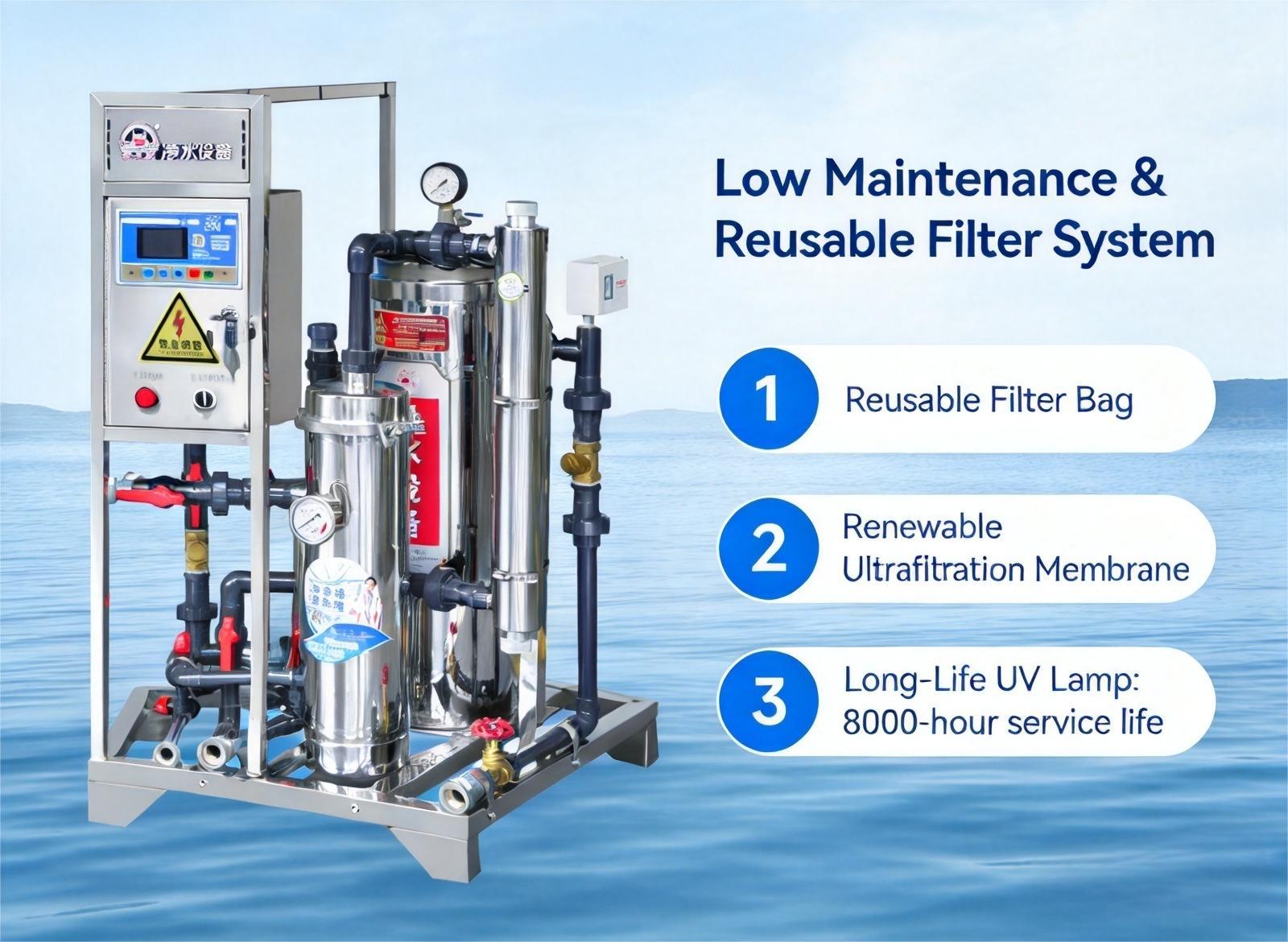
- Components: Pre‑filter, UF membrane, UV lamp, simple pipes
- Maintenance: Flush the membrane manually when flow drops – literally open a valve for 30 seconds
- No electronics (manual flush version available)
- UV lamp replacement – change every 8,000 hours (2‑3 years), plug‑and‑play
> I trained a village health worker in Kenya in 20 minutes. She now flushes the UF membrane every week and checks the UV lamp. She has been managing the system alone for 3 years. No technician visit required.
Reason 5 – Lower Capital Cost: More Villages Served per Dollar
For government aid programs, NGOs, and bulk procurement, cost per village is the key metric.
|
Item |
UF + UV System |
RO System |
|
Equipment cost (1 m³/h) |
$1,200 2,000 |
$3,000 5,000+ |
|
Installation & civil works |
Minimal (no sump, no wastewater pit) |
Expensive (wastewater disposal, power upgrade) |
|
Solar/battery cost |
Small (50W) |
Large (1 2 kW) – 3 5x cost |
|
Total project cost per village |
$2,000 3,500 |
$6,000 12,000+ |
With the same budget, you can install 2‑3 UF+UV systems for every 1 RO system. That means safe water for more families, more villages, more communities.
> A government agency in Zambia had a $100,000 budget for rural water projects. With RO, they could serve 10‑12 villages. With UF+UV, they served 30 villages – reaching over 15,000 people instead of 5,000.
Summary – Choose UF + UV for Africa Groundwater (Save RO for Special Cases)
|
Criterion |
UF + UV ✅ |
RO ❌ |
|
Water quality fit |
Removes sediment, bacteria – perfect for most groundwater |
Designed for high TDS/heavy metals – overkill for 90% of sites |
|
Operating cost |
$50 100/year – minimal |
$300 800+/year – high |
|
Wastewater |
Zero – water saving |
3 4L waste per 1L – wasteful |
|
Power |
20 40W – solar ready |
1 3 kW – grid/generator required |
|
Maintenance |
Simple – local user can manage |
Complex – needs technician |
|
Capital cost |
Low – serve more villages |
High – limited reach |
When should you use RO in Africa?
- If the water has TDS > 1,500 ppm (brackish/seawater intrusion)
- If there is confirmed fluoride or arsenic above WHO limits
- For industrial or medical applications (not for village drinking)
For 90% of rural African villages – UF + UV is the right, sustainable, and affordable choice.
Ready to Implement a UF + UV Solution for Your African Water Project?
If you are an NGO, government agency, distributor, or development partner working on rural water access in Africa, we can help you design cost‑effective, community‑managed systems.
Explore our [UF + UV Water Treatment Systems]– solar‑ready, low‑maintenance models for 100‑2,000 people.
Request a [Free Project Design Consultation]– send us your water test report and village data.
Contact Sophia’s Africa team directly– mention “UF+UV for Africa” for a priority response.
Related News
- How to Reduce Wastewater in Commercial RO Systems Without Sacrificing Membrane Life
- How to Calculate ROI for a Commercial Water Refilling Station
- How to Design a Borehole Water Pretreatment System for Remote Commercial RO Stations
- The "Brain" Behind the System: How VLLRO's Intelligent IoT Control Platform Revolutionizes Water Management
- The Invisible Shield: Why UV Sterilization is Non-Negotiable for Safe Drinking Water
- Maximizing RO Longevity: The Complete Guide to Water Filtration Consumables and Replacement Cycles
Leave me a message